.png)
Gary and Ed's Excellent Adventure

A conversation with newly minted Parkinson lobbyists, Gary Gosselin and Dr. Ed Scully
By David Phreaner, SPCP editor/producer
One of the founding principles of this website is to capture stories of successful community building. We love a good connection story almost as much as a good personality profile. This is the story of two regular guys with Parkinsons who met and impressed all the right people in their journey to becoming lobbyists.
Seacoast Parkinson Community Project is the power of connections. For three days last September, Gary Gosselin, creator of the Resolve Band® (see description below), and Dr. Ed Scully traveled to Washington, DC, to join 250 representatives from 45 states at the Michael J. Fox Policy Research Forum. The goal of the forum was to meet with legislators and staff to lobby for increased research funding to end Parkinsons disease.
Recently, I had the opportunity to interview Gary and Ed about their experience.
---
David Phreaner: Here with me are Gary Gosselin and Dr. Ed Scully, both Parkinsons advocates and people with Parkinsons. So, first question: How did you both get selected to represent New Hampshire in the Fox Foundation Policy Forum in DC last September?
How did you both get selected to represent New Hampshire in the Fox Foundation Policy Forum in DC last September?
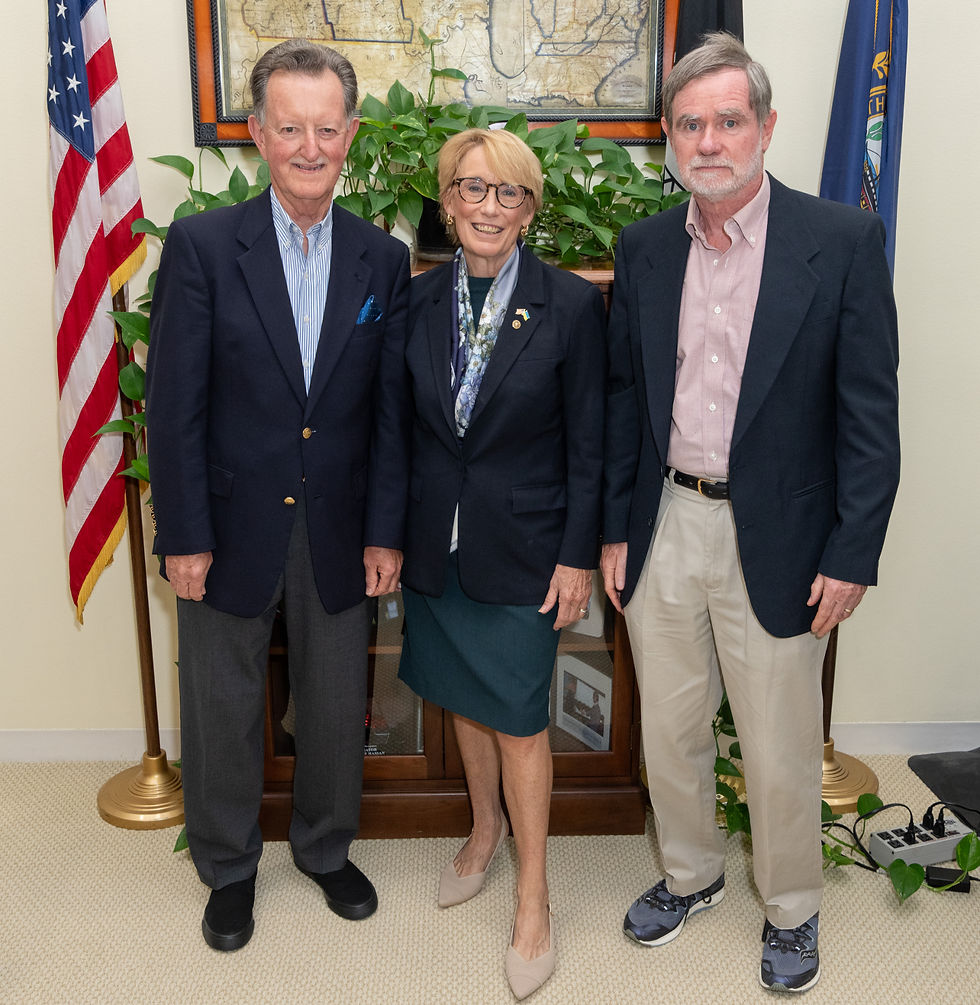
Gary Gosselin: There were several players involved in that. Probably the most important fellow in this whole venture was Dan Tobin [the originator of Seacoast Parkinson’s Expo]. And the reason Dan was such an important figure is that in April of 2025, Dan and I both spoke at a support group meeting at the Northeast Rehabilitation Center. I talked about my wristband, and at the end of the meeting, Dan said to me, “I am doing an Expo for Parkinsons coming up in June. It would be wonderful if you could have a booth there and tell people about the Resolve Band.”
I immediately accepted. Fast forward to June. I was waiting for Dan and the Expo doors to open when a woman came up to me, introduced herself, and said her name was Cathi Thomas.
Come to find out, Cathi Thomas is an Assistant Professor of Neurology at BU and a Program Director for APDA, so I gave her some sample wristbands. She emailed me the next day: “These are wonderful, I am very excited about them, and I’m going to give them to Bill Patjane, who is the Regional Director of Advocacy for APDA. I think it might be something that he’d be interested in.” In July, I got a phone call from Bill. We had a forty-minute conversation about the wristband, my journey, and how I got to where I am. Two days later, I found myself talking to Rebecca Gilbert, the Chief Missions Officer at APDA. She invited me to the Michael J. Fox Forum in Washington, DC. Lo and behold, in August, I was talking to Amy Becker, the Fox Foundation National Advocacy Director. So, from Dan Tobin in April to Amy Becker in August, the next thing I knew, I was meeting Dr. Ed Scully in September at the J.W. Marriott Hotel in Washington, DC—and the rest, as they say, is history.
David: Ed, in an email from Gary, he described you as “a rock star in every meeting.” What did he mean by that?
Ed: The rock star bit has to come from Gary. I was no rock star. My story is very similar to Gary’s. That Expo gave me a chance to meet Cathi Thomas. We were trying to set up some programs for people with Parkinsons and I was using Cathi as a sounding board and as a link to other people at the Expo. Like Gary, I ended up with APDA inviting me down to Washington for the Forum.
David: What exactly is the Parkinsons Policy Forum? And how does that connect with members of Congress?
Ed: The idea of the Forum is over three days to link Parkinsons advocates with their legislators and the Fox Foundation. It was one of the most well-organized meetings I’ve ever been to. The Fox Foundation set up meetings with over 450 representatives. They had people from 45 states meet with their representatives. They had an app for our phones that told us when and where our meetings were. They developed talking points for the meetings. They even provided us with maps! It was really well done, and it's something that they have done on a regular basis for years, except during COVID.
Gary: There were approximately 250 advocates there from 45 states. It was wonderful being able to talk to all these people and to see where we were in New Hampshire in terms of care and available services. I was amazed when talking to people from the Midwest, for instance, to discover that finding a movement disorder specialist is very difficult there compared to here.
One thing we figured out early on is that these members of Congress are drinking from a firehose of Congressional issues. The only way to get them to focus on your issue is to have these kinds of meetings. We were telling them our experiences in one-on-one conversations. It wasn’t so much about policy, although the MJ Fox folks gave us talking points for that.
Instead, Ed and I found that our most persuasive arguments were those we made about ourselves. They appreciated that honesty.
One member we met with shared that their family member has Parkinsons. We would never have found that out if we just went in hammering away, saying, “You’ve got to pass this bill. You've got to give more funding” ... I believe we were listened to because of the direct connection we made.
Frankly, I’m excited to get back there this spring to meet the same folks so they can see the continuity of Ed and me coming back to see them again. It was a great experience.
David: That next meeting is taking place in the spring. It sounds like you both had very good meetings while you were down there. Do you know what led them to invite you back? Was it some particular event or conversation?
Gary: We found an interesting setup for meeting with Senator Maggie Hassan and meeting with Representative Chris Pappas. Ed and I went in individually, did our presentations, and talked to each of them directly.
Senator Jeanne Shaheen could not meet with us. She has seniority on the Appropriations Committee which was meeting. While we weren’t able to meet with Jeanne Shaheen directly, we did meet with senior legislative aide Nick Valenti. Two very senior Michael J. Fox people joined us in that meeting. Ed and I gave our presentations while these two senior Fox Foundation staffers were at the table. I think word got back to Amy Becker [National Advocacy Director of The Fox Foundation], and I think that certainly helped our standing with the program.
I just want to add that we received an email 10 days ago from Amy Becker. She wrote that she would like Ed and me to speak together for about five to seven minutes to welcome everybody to Washington, DC, and to share a bit about our experience at the 2025 Policy Forum, especially how we became buddies, what the forum meant to us, and how we have kept our advocacy going 365 days a year.
What’s going to be different this time is that Ed and I are literally going to open the forum with about three or four hundred people there. And two, old guys from New Hampshire who have no advocacy background are going to be telling these folks how to advocate. It’s a great honor, and we are humbled by it. It’s going to be quite, quite interesting.
Keep reading to learn more about the 2025 Policy Forum.
The 2025 Policy Forum: The National Parkinson’s Project and NIH Funding-Worth Fighting For!
One of the big issues we have in the Parkinson's community is the National Parkinson's Project, the first-ever federal initiative to end Parkinsons disease.
The National Plan to End Parkinson's Act was signed into law by President Biden in July, 2024. It directs the Department of Health and Human Services, led by the National Institutes of Health (NIH), to build a coordinated national strategy that spans research, early diagnosis, treatment, care models, and prevention, with the goal of preventing, slowing, and ultimately curing Parkinson's. As of January 2, 2026, they missed the statutory deadline to seat the Advisory Council. So after they put the law into effect and President Biden signed it, nothing has happened.
This is a pure example of what the Michael J. Fox Foundation is talking about. It’s why we need to go back there and say: “Hey, this is a law. It’s signed. You have a statutory obligation to get this thing going, and nothing’s happened!” That’s a perfect example of what this advocacy is all about.
NIH funding is the other major issue. They are cutting that, as you can imagine, in Washington right now. So that’s really what the policy forum is all about.
Scenes from Washington, DC
4/1/2026 UPDATE: This blog post is from last year but Gary and Ed had the opportunity to go to Washington again this year too! Read about it here.
The Resolve Band: A Note from Gary Gosselin
The Resolve Band began in 2024 as something small and personal. I ordered ten wristbands for family, a few close friends, and members of my care team—just a simple, tangible reminder built around two words that mattered to me: INTENT and Perseverance. I never expected it to go beyond that circle. But people started asking for them. Then support groups did. Then clinicians. What emerged wasn’t demand for a wristband, but a shared symbol—an easy way for people living with Parkinson’s, and those who walk alongside them, to recognize one another and say, “You’re not alone.”

As the band began to travel through clinics, classrooms, and community spaces, I chose to protect the name—not to commercialize it, but to keep its purpose intact. Today, the Resolve Band is still given freely and has become part of my broader advocacy, including work in Washington, D.C., and a presentation at the World Parkinson Congress in Phoenix this spring. Its message remains simple: progress doesn’t come from one big moment, but from showing up, again and again, with INTENT and Perseverance.
Get your Resolve Band here. The only costs involved are postage and a $1 Etsy processing fee. The band itself is shared as a gesture of support, not as a commercial product.


Comments